
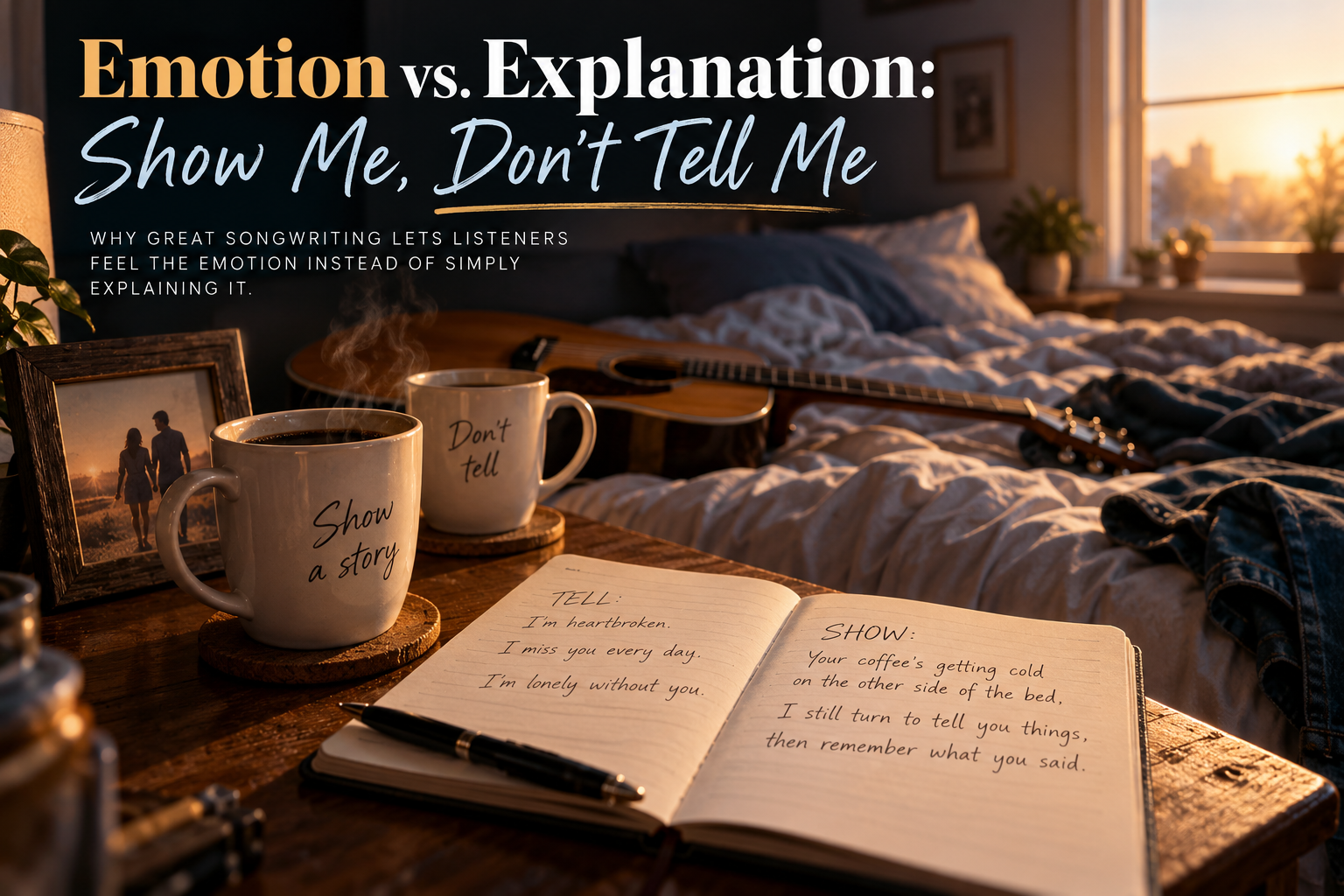
“I’m heartbroken.”
It’s a clear statement. We immediately understand what the songwriter means. But do we actually feel the heartbreak? Maybe a little. The line tells us what’s happening, but it doesn’t yet let us experience what that pain feels like.
Now consider this:
Your coffee’s getting cold on the other side of the bed,
I still turn to tell you things, then remember what you said.
Suddenly, there’s a story. We see the cold coffee, the empty bed, and someone who still instinctively turns to speak to a person who is no longer there.
The songwriter never actually says, “I’m heartbroken.” Yet we feel the sadness.
That’s the power of one of the most important principles in songwriting: Show, Don’t Tell.
Most songs begin with an emotion. Heartbreak, longing, jealousy, hope, or falling in love. That’s a perfectly good starting point. The real challenge is turning that emotion into words, images, and situations the listener can experience.
Consider these lines:
I miss you every day.
I’m lonely without you.
They’re understandable and relatable, but they’re also quite general. They tell us how someone feels without revealing much about the person, the relationship, or the situation.
Try approaching it differently:
Your jacket’s still hanging behind the door,
I can’t bring myself to wear it anymore.
Now the feeling has something tangible attached to it. A jacket remains behind, its owner is gone, and the person left behind isn’t ready to let go of something so ordinary.
That small detail makes the emotion personal.
The listener doesn’t need to be told that someone is hurting. They discover it for themselves.
Songwriters often reach for words like broken, lonely, forever, tears, and pain. These words point directly to an emotion. They can absolutely work, but when we use them too often, they can lose their impact.
A small, specific detail can say so much more.
Think about:
These details aren’t emotions in themselves. They’re moments that reveal emotion.
And that’s where something beautiful happens: listeners bring their own experiences into the song. Maybe the empty chair reminds one person of a parent they’ve lost. Someone else might think of a relationship that ended years ago.
The same lyric can mean something different to every listener.
A great song doesn’t just give the listener a story. It gives them room to find their own story inside it.
A lyric doesn’t have to explain everything. In fact, a powerful line can lose some of its impact when the songwriter immediately explains what it means.
Imagine writing:
I left your picture on the shelf,
I’m broken and alone.
The first line already gives us an image. The second line explains the emotion all over again. Maybe we don’t need that explanation.
What happens if we let the listener connect the dots?
I left your picture on the shelf,
I dust around it every day.
Now the listener starts asking questions. Why is the picture still there? Why hasn’t it been put away? Is it hope, denial, or an inability to let go?
You don’t have to provide the answer. The tension between what happens and what we suspect is what makes the lyric interesting.
This doesn’t mean you should never write directly about feelings. A simple, honest statement can be incredibly powerful at the right moment. The key is balance: have you allowed the listener to experience the emotion before naming it?
This principle isn’t just for heartbreak ballads. It works with almost any subject.
Falling in love
Tell: I’m falling in love with you.
Show: I take the longer road just to pass your street.
Regret
Tell: I wish I could turn back time.
Show: Your last unanswered message is still pinned to my screen.
Hope
Tell: Tomorrow will be a better day.
Show: She opens every window when the morning sun comes in.
Growing older
Tell: The years have gone so fast.
Show: The children’s marks are still on the kitchen door, but nobody measures them anymore.
In each example, we move away from an abstract emotion and toward a concrete situation. The feeling gains a face, a place, and a moment in time.
That’s what makes a lyric feel like a story rather than a statement.
Want to put this principle to work in your own writing? Try this simple exercise.
Write one sentence that captures what your character is feeling.
For example: I’m afraid of losing you.
Try to communicate the same idea without using the words afraid, lose, or love.
What does someone do when they’re afraid of losing another person? Maybe they remember every little detail of a conversation, linger longer at the front door, or ask the same question over and over.
I ask what time you’ll be home,
then ask you once again.
The lyric doesn’t explain the fear. It shows a behavior that suggests it.
Does it sound natural? Does it fit the character and situation? Does it create an image? And perhaps most importantly, does it sound like something a real person would actually say or do?
Remember that songwriting is also about rhythm, melody, and sound. A beautiful description might work on the page but contain too many syllables to sing comfortably. Look for images that don’t just mean something, but also feel good in the melody.
Show, Don’t Tell isn’t a rule you can never break. Sometimes a direct statement is precisely what a song needs.
Think of a chorus where the entire emotional journey comes together in one simple line. Or a moment when, after several verses filled with images and subtle details, the songwriter finally says what they really mean.
After allowing the listener to feel what’s at stake, a line like “I still love you” can hit much harder than if those same words had appeared in the opening line.
The power isn’t in avoiding direct emotion. It’s in choosing the right moment to express it.
First, let the listener experience the feeling. Then, if necessary, give it a name.
A lyric doesn’t have to be complicated to be deeply moving. Sometimes, one carefully chosen image is enough to suggest an entire history.
So, the next time you’re writing a song, ask yourself:
Can I explain this emotion, or can I describe a moment that allows the listener to feel it for themselves?
That small shift can turn an ordinary lyric into a story that stays with people long after the music stops.
Because in the end, we don’t always remember the words a songwriter used to describe an emotion. We remember the image that brought us back to one of our own memories.
At Tunes In Motion, we believe music becomes something more when there’s a story behind it. And sometimes, that story doesn’t begin with what someone says. It begins with what they leave behind, what they keep to themselves, or what they can no longer bring themselves to do.
No music without a story.
Tunes In Motion