
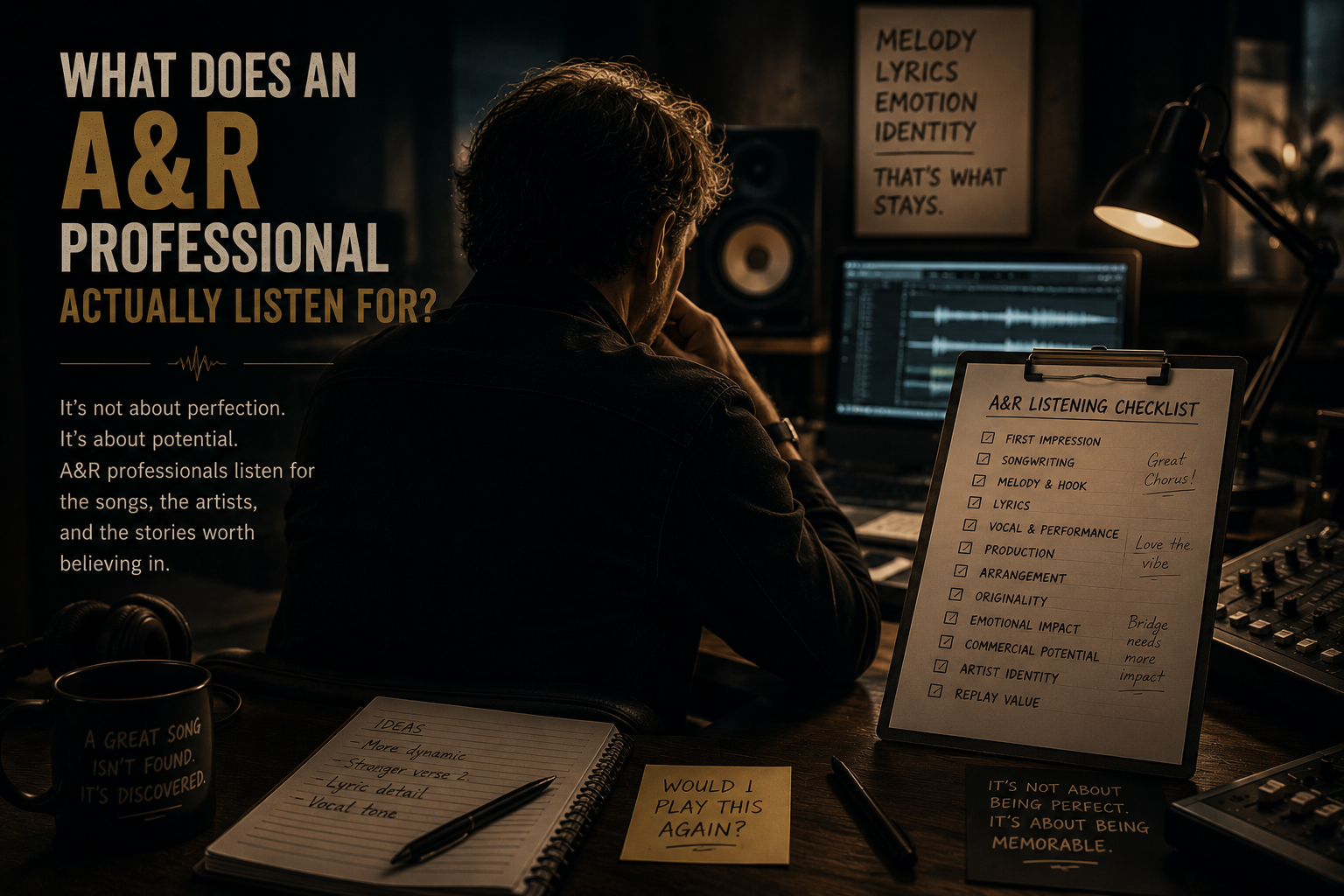
When an A&R professional listens to a new song, they aren’t listening like a fan.
At least, not at first. They are listening for potential. They are asking questions almost instinctively.
And perhaps most importantly:
Does this make me want to hear it again?
That doesn’t mean A&R professionals are searching for perfection.
They are searching for something worth developing. Something that makes them stop analyzing and start paying attention.
So what exactly are they listening for?
The first few seconds matter. Not because every song needs an explosive intro, but because the opening establishes the relationship between the listener and the song.
An A&R professional may immediately notice:
A quiet piano intro can be just as effective as a huge production. The question isn’t:
“Is this impressive?”
It’s:
“Does this make me want to keep listening?”
Once the initial impression has been made, the attention moves toward the foundation.
The song itself.
Strip away the production. Imagine the song performed with nothing but a voice and an instrument. Does it still work? A&R professionals listen for strong songwriting because production trends change quickly.
A great synth sound can become outdated. A production technique can disappear within a year. But a strong melody can remain powerful for decades. That’s why the question is often not:
“Does this production sound current?”
It’s:
“Is there a great song underneath it?”
Melody is one of the strongest indicators of memorability. A good melody doesn’t necessarily have to be complicated. In fact, some of the strongest melodies are remarkably simple.
An A&R professional may ask:
The ultimate test is surprisingly simple:
Can you hum the song when the music isn’t playing?
If you can, something has probably worked.
Every strong song needs something that pulls the listener back. That might be the chorus. But it could also be a lyric, a vocal phrase, a rhythm, an instrumental motif or even a particular production moment.
A hook doesn’t always announce itself. Sometimes you don’t even realize what the hook is until you find yourself repeating it later. That’s the magic.
The best hooks don’t feel forced. They feel inevitable.
Lyrics are more than words that fit a melody. They create meaning.
A&R professionals listen for whether the lyric has something to say and whether it says it in a way that feels authentic.
One of the biggest problems in songwriting is trying too hard to sound like a songwriter.
Sometimes the most powerful lyric is simply the truth.
Not dressed up.
Not over-written.
Just honest.
This doesn’t necessarily mean vocal range. It means identity. Two singers can perform the same song and create completely different experiences.
An A&R professional is listening for the person behind the recording.
And perhaps even more importantly:
Does this artist sound believable?
A technically perfect performance without personality can be less compelling than an imperfect performance with character.
This is where technical analysis starts to disappear. At some point, the question becomes:
Do I feel something?
It doesn’t have to be sadness.
– It could be excitement.
– Nostalgia.
– Desire.
– Hope.
– Anger.
– Joy.
– Melancholy.
– Curiosity.
The emotion simply has to be real.
A&R professionals have heard thousands of technically competent recordings. What they remember are the songs that made them feel something.
Production matters. But its role is often misunderstood. Great production doesn’t simply make a song sound expensive. It creates an environment for the song to exist in.
A&R professionals may listen for:
But production should support the emotional intention of the song.
If the lyric is intimate, perhaps the production should leave room for intimacy. If the chorus is supposed to explode, the arrangement needs somewhere to go.
Production is storytelling through sound.
A song can have a great melody and still lose the listener because the arrangement doesn’t know where to go.
A&R professionals listen for movement.
Every section should have a reason to exist. Not every song needs a traditional structure. But every song needs direction.
This is one of the hardest things to define. A&R professionals aren’t necessarily looking for something nobody has ever heard before. That’s almost impossible. They are looking for a distinctive combination of familiar elements.
A familiar genre with an unusual lyric.
A traditional chord progression with an unexpected melody.
A recognizable vocal style with a different emotional perspective.
Originality often comes from the way familiar ingredients are combined.
The question becomes:
“Why this artist, singing this song, in this way?”
This doesn’t simply mean:
“Could this be a hit?”
Commercial potential is broader.
Commercial potential isn’t about chasing trends. Sometimes the strongest commercial opportunity is finding the right audience rather than trying to appeal to everyone.
This is one of the most revealing questions. The song finishes. Silence.
That reaction matters. Because the ultimate goal isn’t simply to make someone listen. It’s to make them care.
Perhaps the biggest misconception about A&R is that professionals are searching for finished products. Sometimes they are. But often they are looking for potential.
That doesn’t necessarily mean the project should be rejected. It can mean the opposite. There may be something worth investing in.
A&R professionals also listen for things that can hold a song back.
For example:
– A strong production hiding a weak song.
– Lyrics that sound generic.
– A chorus that never arrives emotionally.
– Too many ideas competing for attention.
– A vocal performance without personality.
– A structure that feels predictable without being satisfying.
– Production that follows trends but lacks identity.
None of these automatically make a song bad. But they can prevent a good song from becoming a memorable one.
Try listening to your song three different ways.
Listen One: The Listener
Don’t analyze anything.
Just listen.
Listen Two: The Songwriter
Now listen to the composition. Focus on melody, lyrics, structure, harmony and hooks.
Ask:
Does the song work without the production?
Listen Three: The A&R Professional
Now step back.
Ask:
That third listen can reveal things you completely missed during the first two.
Ultimately, most A&R questions lead back to one thing.
Potential.
Not:
“Is this flawless?”
But:
“Is there something here worth believing in?”
That something might be a voice.
– A lyric.
– A melody.
– An artist.
– A story.
– A sound.
Or simply a feeling that refuses to go away. That’s what makes A&R so difficult. And so exciting. Because sometimes a song doesn’t arrive fully formed. Sometimes you hear it and immediately know. Sometimes you hear it twice. Sometimes you need to imagine what it could become.
But when you hear that combination of songwriting, identity and emotion, something changes.
You stop listening like an evaluator. You start listening like a fan. And you press play again.
At Tunes In Motion, this is the philosophy behind our professional song evaluations. We don’t simply ask whether a song is good. We look at the elements an artist, songwriter, producer or A&R professional needs to understand before taking the next step.
Songwriting.
Lyrics.
Melody.
Harmony.
Vocals.
Production.
Arrangement.
Originality.
Emotional impact.
Commercial potential.
Artist identity.
Release readiness.
The goal isn’t to tell you what you want to hear.
It’s to give you an objective perspective on what is actually working — and where the opportunity for improvement lies.
Because sometimes the most valuable feedback isn’t:
“This song is great.”
It’s:
“This is the part that makes people stop.”
And knowing exactly what that part is can change the way you write your next song.
Before releasing your next song, find out how it stands up from an A&R perspective.
Tunes In Motion Professional Song Review & A&R Evaluation
Objective feedback.
Professional perspective.
Actionable insight.
Because your song deserves more than another opinion from someone who simply likes or dislikes it.
It deserves to be heard like a professional would hear it.
Submit your song to Tunes In Motion and discover its real potential.