
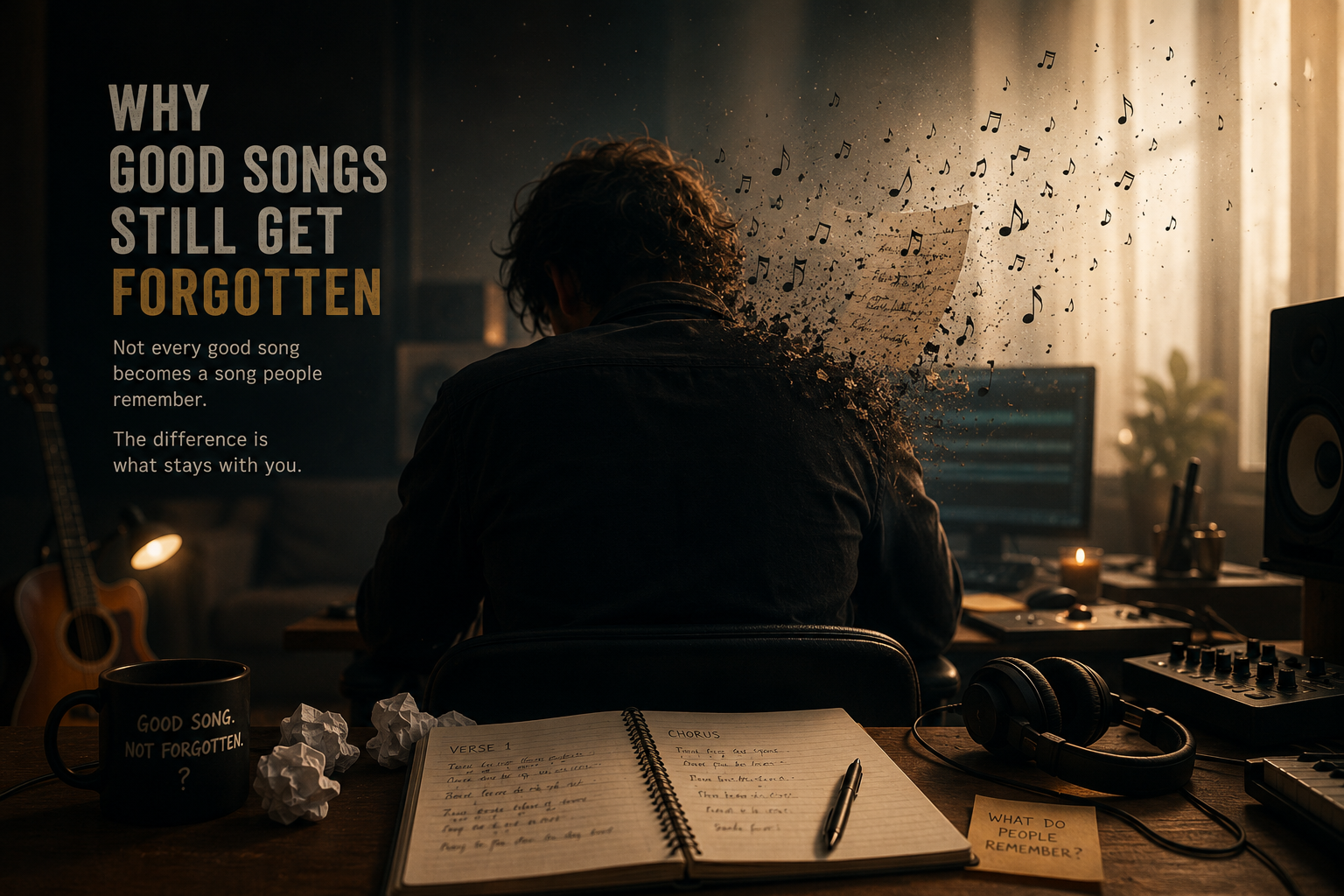
A song can be good and still be forgotten.
It can have a beautiful melody, thoughtful lyrics, a strong vocal performance, and a polished production. Nothing is obviously wrong with it. You listen from beginning to end and think:
“This is a good song.”
And then, ten minutes later, you can’t remember how the chorus went. That is one of the hardest realities of songwriting.
Because there is a significant difference between a song that is good and a song that stays with you.
In the previous blog, What Makes a Song Feel Like a Hit?, we looked at the elements that can make a song memorable. But there is another side to that question:
The answer often has less to do with quality than with connection.
Quality Isn’t the Problem
One of the easiest mistakes a songwriter can make is assuming that if a song is technically good, people will automatically respond to it. But listeners don’t grade songs. They don’t sit there thinking:
“The chord progression is excellent, the vocal is well recorded, and the production deserves an 8.5.”
They simply listen. And within a very short time, their brain is already deciding whether the song deserves their attention. That’s why a technically impressive song can still feel strangely forgettable. It may be well made without being distinctive. And distinctive is what gives a song an identity.
Think about some of the songs you remember most clearly. There is often a moment attached to them.
A line. A melody. A change in the vocal. A chord progression. A particular sound. Sometimes it’s something incredibly simple.
You may not remember the entire song. You may not even remember the verses. But you remember that moment. That’s important.
A song doesn’t necessarily need ten memorable moments. Sometimes it only needs one. One moment that makes the listener think:
“That’s the part.”
If a song moves smoothly from beginning to end but never creates such a moment, it can be enjoyable without becoming memorable.
This is particularly important when writing and producing. A song can contain a lot of movement.
New instruments enter. Drums change. Backing vocals appear. The arrangement becomes bigger. The production evolves.
But does the emotional story actually move forward? There is a difference. Adding something to a track doesn’t automatically make the song develop.
Sometimes a production becomes increasingly busy while the emotional message remains exactly where it was thirty seconds earlier.
The listener hears activity. But they don’t necessarily feel progression. Great arrangements don’t simply add elements. They create contrast, anticipation and release.
There is a common assumption in songwriting that the chorus has to be larger than everything that came before it.
More drums. More vocals. More instruments. More harmonies. More energy.
Sometimes that works beautifully. But bigger isn’t automatically better. A chorus can become more powerful simply because the verse created enough space for it. Sometimes the most effective chorus is the one that changes the emotional temperature rather than the volume.
Maybe the verse feels intimate and the chorus becomes open. Maybe the verse is rhythmically busy and the chorus becomes simple.
Maybe everything drops away and the vocal suddenly stands alone.
Contrast creates impact. Without contrast, even a huge chorus can feel ordinary.
There’s another reason good songs sometimes disappear: the lyrics don’t take enough emotional risk.
A songwriter may spend hours trying to make every line sound beautiful.
The rhyme is perfect.
The imagery is elegant.
The vocabulary is sophisticated.
But somewhere along the way, the songwriter stops saying something personal and starts saying something that simply sounds like a song. That’s dangerous.
Listeners don’t necessarily connect with complicated language. They connect with recognition. A line that makes someone think:
“I’ve felt exactly that.”
Sometimes the strongest lyric isn’t the most poetic one. It’s the most honest one.
Specific Beats Generic
Compare these two ideas:
“I miss you every night.”
And:
“Your coffee cup is still sitting by the window.”
The first tells us what the writer feels. The second gives us something we can see.
Specific details create worlds. They allow the listener to step inside the song rather than simply being told what the songwriter is feeling. That’s one of the most powerful tools available to a lyricist.
Don’t only tell us that someone is lonely. Show us what loneliness looks like.
The empty side of the bed. A name still saved in a phone. A jacket hanging behind the door. A message that was never sent.
Those details are where songs become personal. And strangely enough, personal often becomes universal.
Familiarity Helps — But Predictability Hurts
A memorable song usually gives the listener something familiar to hold onto.
But familiarity has a limit. If the listener knows exactly what is coming before it happens, curiosity disappears.
The best songs often balance two opposing forces:
Recognition and surprise.
Give the listener enough familiarity to feel comfortable. Then give them something they didn’t expect. It might be a melodic turn. A different chord. A lyric that changes the meaning of the previous line. A pause before the final word. A completely unexpected bridge.
You don’t need to reinvent songwriting. You just need to give the listener a reason to lean forward.
The first listen can be misleading. Production can impress you. A powerful vocal can grab your attention. A dramatic intro can create excitement. But what happens when the production becomes familiar?
That’s when the songwriting has to take over. Ask yourself:
What makes me want to hear this again?
Not:
“What do I like about it?”
Those are different questions. You can like a song without needing to hear it again.
The songs that matter are often the ones where the listener feels there is still something unresolved. Something they want to experience one more time.
This may be one of the most difficult things to do. When you’ve written a song, you know everything about it.
You know why that chord is there. You know what happened during the recording session. You know why the bridge changes. You know which vocal take was the hardest. You know what the lyric means.
The listener knows none of that. They only know what they hear. That’s why stepping away from your song can be so valuable.
Listen to it as if someone else wrote it.
Don’t defend it. Don’t explain it. Don’t fill in the gaps with information the listener doesn’t have.
Just listen. And ask:
If I hadn’t written this song, would I remember it tomorrow?
From an A&R perspective, a song doesn’t have to be perfect to be interesting. In fact, sometimes the opposite is true.
A song with a unique identity and one or two weaknesses can be more exciting than a flawless song that sounds like everything else. A&R professionals are listening for potential.
Is there an artist here? Is there a songwriter here? Is there a voice? Is there an identity? Is there something that could become bigger with the right development?
That’s why feedback shouldn’t simply tell you whether a song is “good.” The more useful question is:
What is already working — and what is preventing the song from becoming stronger?
When a song isn’t connecting, the instinct is often to add something.
Another harmony. Another synth. Another guitar. Another production effect. Another lyric.
But sometimes the solution is subtraction.
Create space. Silence can be powerful.
A single voice can be more emotional than four layered vocals. One piano chord can sometimes say more than an entire arrangement. The question isn’t:
“What else can we add?”
It’s:
“What can we remove without losing the song?”
That question can completely change a production.
Ultimately, a memorable song develops an identity.
You can hear a few seconds and recognize it. You can remember a line without hearing the melody. You can hum the chorus. You can associate it with a feeling, a place, a person or a moment in your own life.
That’s when the song stops belonging entirely to the songwriter. It becomes part of the listener’s world. And that is perhaps the greatest achievement a song can have.
Usually, it’s not because they are bad. Sometimes they simply don’t give the listener enough to hold onto. There may be no defining moment.
No emotional surprise. No distinctive perspective. No memorable melodic identity. No reason to press play again.
And sometimes the song has all of those things — but they’re buried underneath too much production, too many ideas, or lyrics that never quite become personal.
The good news is that these things can often be identified. And once you can identify them, you can work on them.
Before You Release Your Song, Ask Yourself
Listen once. Then put it away. Come back tomorrow. Now ask yourself:
What do I remember?
If you remember a melody, that’s something. If you remember a lyric, that’s something. If you remember a feeling, that’s something. If you remember a specific moment, that’s even better.
But if all you remember is that the song sounded “good,” there may still be work to do.
Because good gets listened to.
Memorable gets replayed.
And replayed is where the real connection begins.
At Tunes In Motion, we believe a song deserves to be evaluated as more than a technical exercise.
A strong A&R evaluation looks at the complete picture:
Songwriting.
Lyrics.
Melody.
Performance.
Production.
Identity.
Emotional impact.
Commercial potential.
Not simply whether the song is good. But whether there is something inside it that can make people stop, listen, remember — and come back. Because sometimes the difference between a good song and a great one isn’t another layer of production.
It’s one idea. One line.One melody. One moment.
The moment the listener doesn’t just hear the song.
They remember it.
At Tunes In Motion, our professional A&R evaluations are designed to give songwriters and artists an objective perspective on their work.
We look beyond technical quality and ask the questions that matter:
And most importantly:
Is there something here that people will remember?
Sometimes an outside perspective is all it takes to hear what you’ve been too close to hear yourself.
Submit your song to Tunes In Motion and discover its real potential.