
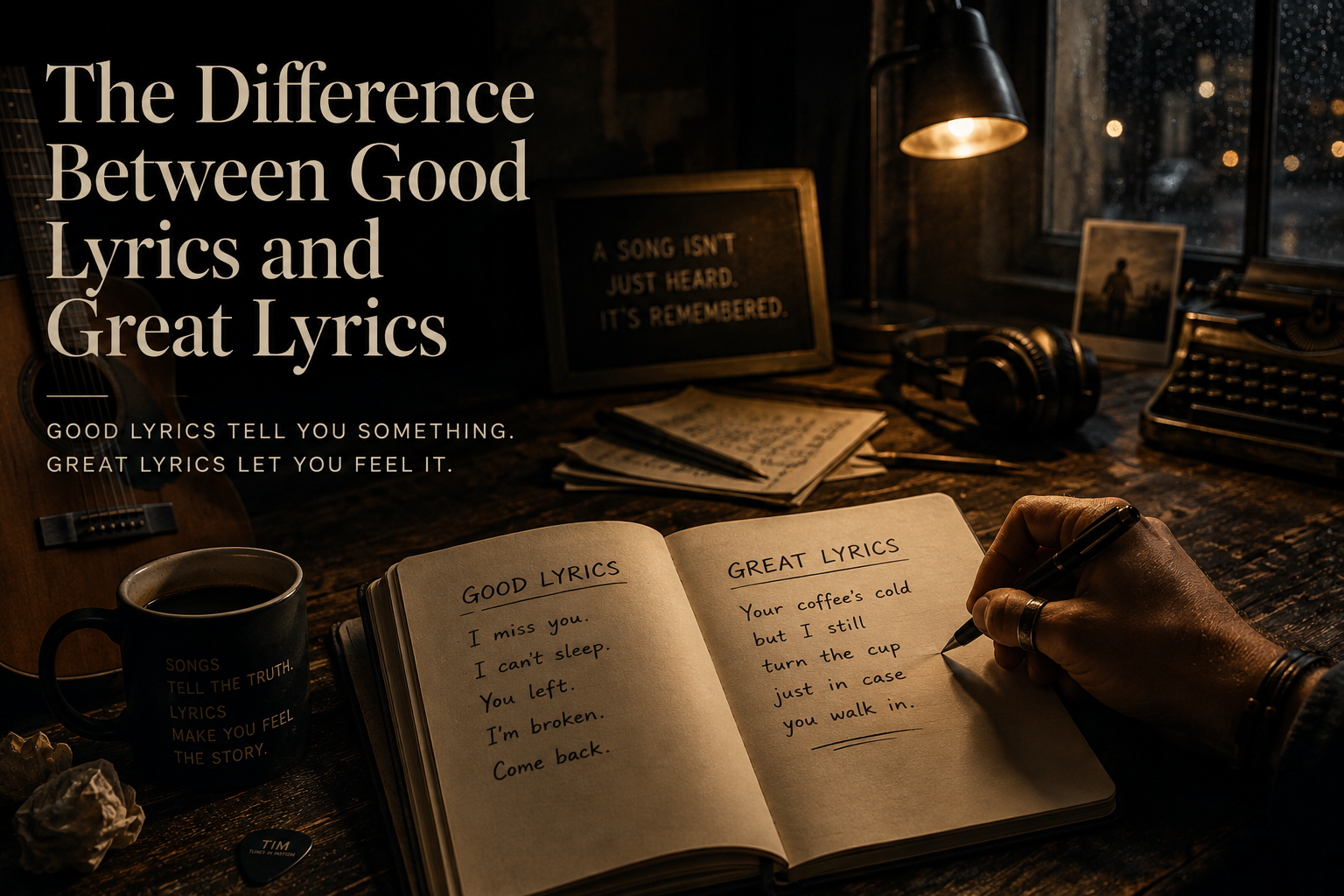
A good lyric can tell you a story. A great lyric can make you feel like you lived it. That difference is harder to define than it sounds.
Most songwriters know when a lyric is technically strong. The words make sense. The rhymes work. The structure is solid. The story has a beginning, a middle, and an end.
But songwriting isn’t a writing competition. A lyric doesn’t become great because every line is clever. It becomes great when the listener stops hearing words and starts experiencing something.
That’s where the real difference begins.
A good lyric communicates. It tells you what happened, what someone feels, what they want, or what they have lost. There is nothing wrong with that. In fact, clarity is one of the most important qualities in songwriting. If the listener has no idea what a song is about, emotional connection becomes much harder.
But good lyrics can sometimes remain on the surface. They tell us:
The listener understands the message. But understanding isn’t always the same as feeling. Great lyrics take the next step.
Imagine two songwriters are writing about the end of a relationship. One writes:
I can’t sleep since you left
I keep thinking about you
Everything reminds me of us
The emotion is clear.
Now imagine the songwriter never actually says that they’re heartbroken. Instead, we see an empty side of the bed.
A coffee cup that hasn’t been moved. A name still saved in a phone. A jacket hanging behind the door. Suddenly, the listener isn’t being told what to feel. They’re discovering it. That’s powerful. Because the listener brings their own memories into the song.
And when that happens, the lyric stops being just the songwriter’s story. It becomes theirs too.
One of the easiest ways to make a lyric more powerful is to become more specific.
I miss you is universal.
But universality doesn’t mean vagueness.
Think about the details that only belong to one particular relationship, one particular place, or one particular moment. The song doesn’t need ten of them. Sometimes one detail is enough. A street name. A cheap bottle of wine. A photograph with a torn corner. The sound of someone’s keys at the front door.
Specific details create pictures. Pictures create memories. And memories create emotional connection.
That’s why the best lyrics often feel incredibly personal while somehow becoming incredibly relatable.
Songwriters sometimes worry that everything has already been written.
Love. Loss. Jealousy. Hope. Regret. Starting over. They’re right. We’ve been singing about these things for thousands of years. But the emotion isn’t what makes a lyric original.
Two people can write about heartbreak and create completely different songs. The question is not:
“Has someone written about this before?”
The question is:
“Have I said it in a way that sounds like me?”
That’s where artist identity starts to appear.
A strong lyric sounds like it could only have been written by that songwriter. Not because the vocabulary is unusual. Not because every line is poetic. But because there is a particular way of seeing the world behind the words.
Maybe it’s vulnerable. Maybe it’s dry and ironic. Maybe it’s brutally direct. Maybe it’s romantic without being sentimental. Maybe it’s observational and full of small details. That voice matters.
An A&R professional isn’t only asking whether the lyric works. They’re listening for the person behind it.
Who is this artist? What do they see that someone else might miss?
That’s a much harder question to answer. And a much more valuable one.
A lyric can rhyme beautifully and still say very little. This is where songwriting can become dangerous. Once the rhyme starts driving the writing, meaning can become secondary.
A songwriter finds the perfect rhyme and then builds a line around it. Technically, it works. Emotionally, it may not.
The listener doesn’t care how difficult the rhyme was to find. They care whether the line means something.
A great lyric puts the emotion first and the technique in service of it. Sometimes the strongest line doesn’t rhyme at all. Sometimes the most memorable phrase is the simplest one in the song.
Songwriters often overwork their lyrics. A line gets rewritten ten times. A metaphor becomes more sophisticated. A simple phrase becomes something more “poetic.” And somewhere along the way, the original honesty disappears. That’s why editing isn’t always about making a lyric more impressive.
Sometimes it’s about making it more honest. Read the lyric out loud. Look for the line that sounds like something you would actually say. Then ask yourself:
Does this sound like a songwriter trying to write a lyric — or does it sound like a person telling me the truth?
That distinction can change everything.
When an A&R professional reads or hears a lyric, they’re not grading it like a school assignment. They’re looking for signs of an artist.
Most importantly:
Does this lyric make me want to hear the song again?
A technically perfect lyric without identity may be forgotten. A slightly imperfect lyric with a powerful voice can stay with you.
That’s why A&R isn’t always looking for perfection. They’re looking for something worth developing.
Good lyrics communicate an idea. Great lyrics create a feeling. Good lyrics tell a story. Great lyrics make you see it. Good lyrics use words effectively. Great lyrics make those words feel inevitable. And good lyrics can belong to anyone.
Great lyrics feel like they could only belong to one artist. That’s ultimately what you’re looking for as a songwriter. Not the cleverest line. Not the most complicated metaphor. Not the perfect rhyme. You’re looking for that moment when a listener hears a line and thinks:
“I’ve felt that. I just never knew how to say it.”
That’s when lyrics stop being words on a page. That’s when they become a song.
When A&R hears hundreds of songs, technical skill alone doesn’t make one stand out.
A great lyric gives them a glimpse of the artist behind the song.
And sometimes, one honest line is enough to make someone stop listening as an evaluator and start listening as a fan.
That’s the difference between good lyrics and great lyrics.
At Tunes In Motion, our TIM A&R LYRIC V1 evaluation looks beyond grammar and rhyme. We assess your lyrics the way an A&R professional or experienced songwriter would—focusing on storytelling, emotional impact, originality, structure, commercial appeal, and overall artistic potential.
Whether you’ve written your very first lyric or you’re preparing songs for professional release, objective feedback can help you take the next step with confidence.
Submit your lyrics today and discover how your words stand up to a professional A&R review.