
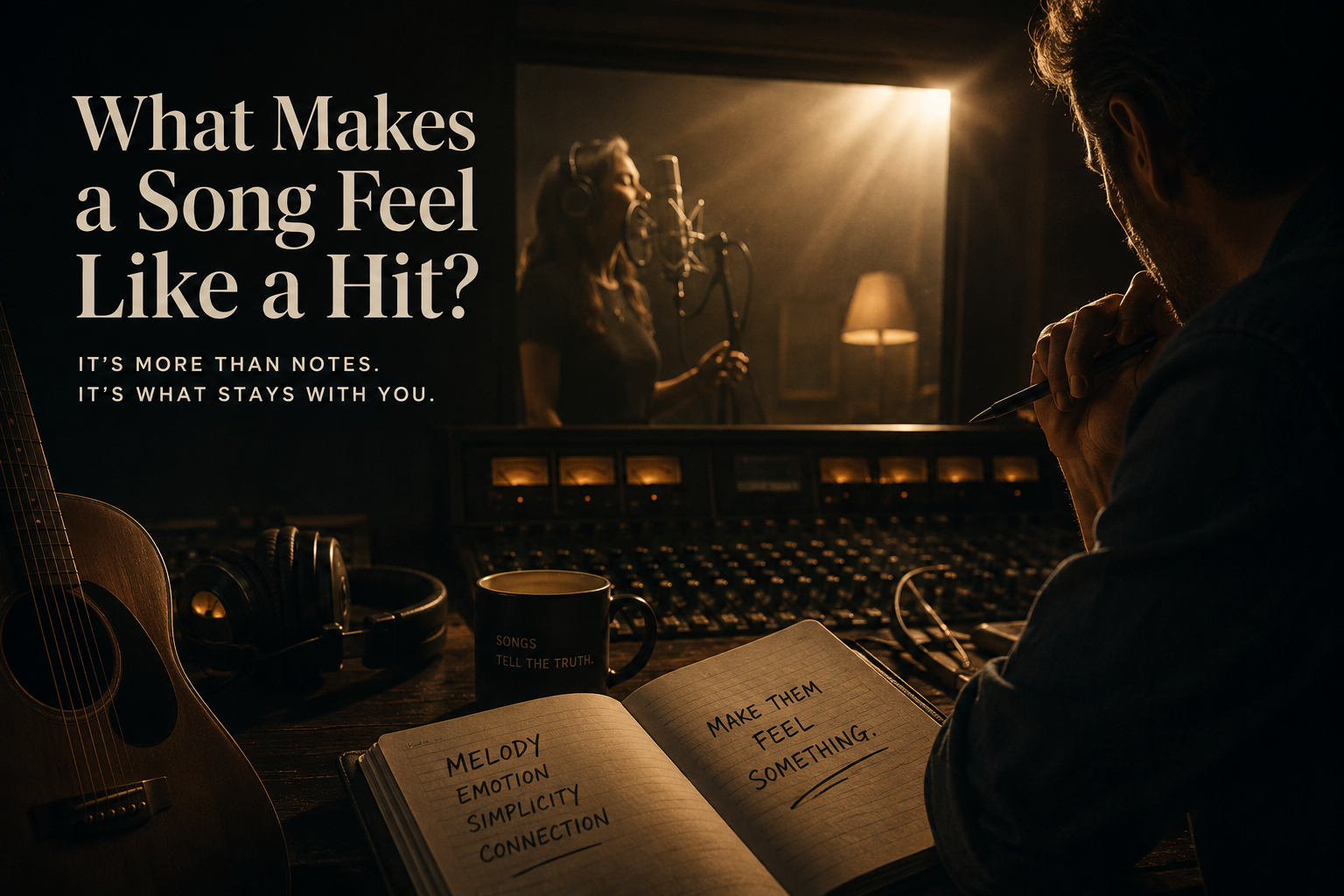
A great song doesn’t always announce itself. Sometimes there’s no huge production, no spectacular vocal performance, and no complicated arrangement. Just a melody, a voice, and something you can’t quite explain that makes you want to hear it again. That feeling matters.
Because in a world where A&R teams, producers, publishers, playlist editors, and listeners hear thousands of songs every year, being good is rarely enough.
A song has to make people feel something. More importantly, it has to give them a reason to keep listening.
Before an A&R professional hears the second verse, the bridge, or the final chorus, an impression has already been formed.
That doesn’t mean every song needs to explode from the first note. It means the opening needs a purpose. Maybe it’s a vocal that immediately creates curiosity. A distinctive guitar line. A lyric that makes you wonder what happens next. The first 30 seconds aren’t necessarily about showing everything. They’re about creating anticipation.
If the listener doesn’t have a reason to stay, they may never reach the part where the song becomes great.
Production can make a good song sound bigger. It can’t always make a weak melody memorable. A track can have impressive drums, beautiful synths, layered guitars, backing vocals, and a perfectly polished mix. But strip all of that away and ask yourself:
If the melody survives with nothing but a voice and an instrument, you probably have something worth building around.
That’s not an argument against production. Quite the opposite. Great production reveals the strength of a song. It shouldn’t have to hide its weaknesses.
A hook isn’t necessarily a phrase repeated eight times. Sometimes the hook is a feeling.
It might be the moment when the melody suddenly lifts. A lyric that says exactly what the listener has felt but couldn’t put into words. A vocal performance that cracks at precisely the right moment. These moments are difficult to manufacture. And that’s why they matter.
People don’t remember every production detail of a song. They remember the part that stayed with them. The emotional hook is often what brings them back.
Some of the most memorable songs are built around remarkably simple ideas.
That simplicity can be deceptive. Writing something complicated can be easier than writing something simple that feels inevitable.
Great songwriting often comes from knowing what to remove. Every word doesn’t need to be clever. Every section doesn’t need another idea.
Sometimes the strongest creative decision is knowing when you’ve already said enough.
A technically perfect vocal isn’t necessarily the right vocal. Sometimes the performance that connects most is the one with a little imperfection in it.
The listener doesn’t hear vocal technique in isolation. They hear a person. And that human element can be the difference between hearing a song and believing it.
Modern production gives us almost unlimited possibilities. That can be both a gift and a problem. It’s easy to keep adding. Another layer. Another effect. Another harmony. Another synth. Eventually, the production can become more interesting than the song itself.
The best production decisions aren’t always the ones that make a track sound bigger. Sometimes they’re the decisions that make you notice the lyric.
Production is at its best when you stop thinking about the production and start experiencing the song.
This may be the hardest lesson for any songwriter.
A song can be well written. Well performed. Well produced. Well mixed. And still disappear after the final note. That’s not necessarily because something is wrong. There is simply a difference between quality and identity.
A memorable song has something that belongs specifically to that song.
Something that makes it difficult to replace with another song. That’s what A&R professionals are listening for.
Not perfection. Potential.
Here’s a simple test. Listen to your song today. Then don’t play it again. Come back tomorrow. What do you remember?
That answer can tell you more than another ten listens in a row. When you’ve worked on a song for weeks or months, every detail becomes familiar. You know every fill, every chord change, every vocal layer. The listener doesn’t. They hear it once. Maybe twice. And then they move on.
A great song has to survive that first encounter.
There isn’t one formula. If there were, everyone would be writing hits. But there are patterns.
A strong song usually has something worth discovering. Something worth remembering. Something emotionally honest. And something that makes the listener want to come back.
It doesn’t have to be loud. It doesn’t have to follow every trend. It doesn’t even have to sound like anything else on the market. But it has to give the listener a reason to care. And perhaps that’s the real difference.
A good song makes you listen. A memorable song makes you listen again. And a great song? You find yourself singing it when the music isn’t even playing.
When an A&R professional hears a new song, the question isn’t simply:
“Is this good?”
The more important question is:
“Is there something here that people will remember?”
That’s where songwriting, performance, production, and identity come together. Sometimes you can hear that potential within the first minute. Other times, it takes three listens. But when the right song comes along, there is usually a moment when you stop analyzing it and simply think:
I want to hear that again.
That’s the moment every songwriter is chasing.
At Tunes In Motion, our TIM evaluation looks beyond grammar and rhyme. We assess your lyrics the way an A&R professional or experienced songwriter would—focusing on storytelling, emotional impact, originality, structure, commercial appeal, and overall artistic potential.
Whether you’ve written your very first lyric or you’re preparing songs for professional release, objective feedback can help you take the next step with confidence.
Submit your lyrics today and discover how your words stand up to a professional A&R review.